Archive for the ‘Payroll’ Category

What Is FICA Tax? Rates, Calculations & How It Works

Article Summary:

  • FICA tax is a mandatory U.S. payroll tax that funds Social Security and Medicare programs.
  • Employees generally pay 7.65% of eligible wages, while employers contribute a matching 7.65%.
  • FICA consists of two components: Social Security tax (6.2%) and Medicare tax (1.45%).
  • Self-employed individuals typically pay the full 15.3% under Self-Employment Contributions Act (SECA) rules.
  • FICA taxes are calculated using gross taxable wages before most payroll deductions.
  • Social Security tax is subject to an annual wage limit, while Medicare tax applies to all eligible wages.
  • Understanding FICA tax rates and payroll calculations helps businesses maintain compliance and avoid reporting errors.

When reviewing a paycheck, most employees focus on the amount they receive. However, understanding payroll deductions is just as important. One of the most common deductions employers calculate and withhold is FICA tax.

It appears on nearly every U.S. paycheck and directly funds Social Security and Medicare programs. For businesses, managing FICA taxes correctly is critical. Accurate payroll reporting helps prevent penalties, compliance issues, and employee disputes.

In this guide, we will break down what is FICA tax, the latest FICA tax rate, and how payroll calculations work in real-world situations.

What Is FICA Tax?

FICA tax stands for the Federal Insurance Contributions Act tax. It is a mandatory U.S. payroll tax that funds Social Security and Medicare.

Both employees and employers contribute toward these taxes. Each side pays 7.65% of the employee’s gross wages.

If you are wondering what is FICA tax, think of it as a shared payroll contribution system supporting federal benefit programs.

These taxes help fund:

  • Social Security retirement benefits
  • Disability benefits
  • Survivor benefits
  • Medicare healthcare coverage

Unlike federal income tax, FICA taxes follow fixed percentage rates. They are not calculated using income tax brackets.

Employers deduct the employee portion directly from paychecks. Then, employers contribute an equal matching amount separately.

Self-employed individuals handle things differently. Since they act as both employer and employee, they must pay the full 15.3% themselves.

Quick Answer:

FICA tax is a mandatory U.S. payroll tax that funds Social Security and Medicare programs. Employees generally pay 7.65% of eligible wages, consisting of 6.2% for Social Security and 1.45% for Medicare, while employers contribute a matching amount. Self-employed individuals typically pay the full 15.3% under SECA rules. FICA taxes are automatically withheld from employee paychecks and help fund retirement, disability, survivor, and healthcare benefits.

What Are The Components of FICA Tax?

To fully understand the FICA tax meaning, you need to look at its two separate components.

Tax Component Employee Rate Employer Rate Total Rate
Social Security 6.2% 6.2% 12.4%
Medicare 1.45% 1.45% 2.9%
Total Standard FICA Tax 7.65% 7.65% 15.3%

Together, these taxes make up the standard FICA tax rate.

Although the percentages stay fixed, each tax serves a different purpose.

Social Security Tax (OASDI)

The Social Security portion funds:

  • Retirement benefits
  • Disability benefits
  • Survivor benefits

This tax applies only up to a yearly wage limit. Currently, the limit is $184,500.

Once employee earnings cross that threshold, additional wages are exempt from Social Security tax.

Medicare Tax

The Medicare portion helps fund hospital and medical insurance programs.

Unlike Social Security tax, Medicare tax applies to all eligible wages without a cap.

High earners may also owe an Additional Medicare Tax of 0.9%.

This extra tax applies when wages exceed:

  • $200,000 for single filers
  • $250,000 for married couples filing jointly

Employers do not match this additional 0.9% portion.

Also Read: What Is a Tax Burden?

What Is the Current FICA Tax Rate?

One of the most common payroll questions is: what is the FICA tax rate today?

The standard rates currently include:

Tax Type Rate
Social Security 6.2%
Medicare 1.45%
Total Employee FICA Tax Rate 7.65%

Employers must contribute another matching 7.65%.

That means the total contribution toward Social Security and Medicare equals 15.3%.

Employees often ask, how much is FICA tax on a paycheck. The answer depends entirely on gross taxable wages.

As wages increase, payroll deductions increase too. However, Social Security tax stops after reaching the annual wage limit.

Medicare taxes continue regardless of income level.

How to Calculate FICA Tax

Businesses must understand how to calculate FICA tax correctly. Small payroll errors can create serious compliance issues later.

FICA taxes are calculated using an employee’s gross pay before deductions. This includes earnings before:

  • Federal income tax withholding
  • Health insurance deductions
  • Retirement contributions
  • Other payroll deductions

Let’s look at a simple example.

Suppose an employee earns $100,000 annually.

Step 1: Calculate Social Security Tax

$100,000 × 6.2% = $6,200

The employee pays $6,200 in Social Security tax.

Step 2: Calculate Medicare Tax

$100,000 × 1.45% = $1,450

The employee pays $1,450 in Medicare tax.

Step 3: Calculate Total Employee FICA Tax

$6,200 + $1,450 = $7,650

The total employee FICA tax equals $7,650.

The employer must contribute an equal amount of $7,650.

As a result, the combined FICA contribution is:

$7,650 + $7,650 = $15,300

This total supports Social Security and Medicare programs.

Although the formula appears straightforward, payroll calculations become more complex when bonuses, overtime pay, multi-state employment, and additional Medicare taxes apply.

How Are FICA Taxes Deducted for Employees?

For employees, FICA taxes are usually deducted automatically from every paycheck.

The employer handles:

  • Payroll tax calculations
  • Employee withholdings
  • Employer contributions
  • IRS deposits
  • Payroll reporting

Employees do not need to calculate taxes manually each pay cycle.

Instead, deductions appear directly on pay stubs under Social Security and Medicare sections.

Because employers manage the process internally, accurate payroll systems become extremely important.

Also Read: How to Calculate Net Income

How Are FICA Taxes Deducted for Self-Employed Individuals?

Self-employed individuals follow a different system.

Since there is no employer contributing separately, self-employed taxpayers must pay the entire 15.3% themselves.

This falls under the Self-Employment Contributions Act, commonly called SECA.

Under SECA:

  • 12.4% goes toward Social Security
  • 2.9% goes toward Medicare

These taxes are usually paid through quarterly estimated tax payments to the IRS.

However, there is one important tax benefit.

Self-employed individuals can generally deduct half of their self-employment tax as an adjustment on their income tax return.

This deduction helps reduce taxable income.

Is FICA the Same as Federal Income Tax?

Many employees ask, is FICA the same as federal income tax? The answer is no.

Although both appear on paychecks, they work very differently.

Category FICA Tax Federal Income Tax
Purpose Funds Social Security and Medicare Funds federal government operations
Calculation Method Fixed percentage rates Progressive tax brackets
Employer Contribution Required Not required
Wage Limits Partial limits apply No wage cap

Federal income tax depends on:

  • Filing status
  • W-4 selections
  • Tax brackets
  • Additional withholding elections

Meanwhile, FICA taxes follow fixed payroll percentages.

Understanding this distinction helps businesses explain paycheck deductions more clearly.

Why Is Accurate FICA Tax Management Important for Payroll?

Payroll compliance becomes more difficult as businesses grow. Manual processes often increase the risk of reporting errors.

Businesses commonly struggle with:

  • Payroll calculation mistakes
  • Late tax deposits
  • Incorrect employee classiFICAtions
  • Multi-state payroll rules
  • Year-end reporting issues
  • Compliance tracking

These problems can create IRS penalties and operational stress quickly.

That is why many companies outsource payroll and accounting support to experienced financial partners.

Streamline Payroll and Tax Management With Expert Support

Understanding FICA tax helps businesses manage payroll more confidently. It also helps employees understand paycheck deductions better.

Managing payroll internally requires time, accuracy, and compliance expertise. Growing businesses often need additional support.

Global FPO helps businesses streamline payroll, bookkeeping, and accounting operations through scalable financial support services.

Simplify Payroll and Compliance Management

Managing payroll taxes and reporting requirements can be time-consuming. Global FPO helps businesses streamline payroll, bookkeeping, and accounting processes with reliable financial support.

Get Expert Support

FAQs

Que: 1. What is FICA tax?

Ans. FICA tax is a mandatory payroll tax funding Social Security and Medicare programs.

Que: 2. What is the current FICA tax rate?

Ans. The employee FICA tax rate is currently 7.65% of gross wages.

Que: 3. How much is FICA tax for self-employed individuals?

Ans. Self-employed individuals usually pay the full 15.3% under SECA tax rules.

Que: 4. How to calculate FICA tax?

Ans. To calculate FICA tax, apply Social Security and Medicare percentages to gross taxable wages.

Que: 5. Is FICA the same as federal income tax?

Ans. No. FICA taxes fund Social Security and Medicare, not general government operations.

Que: 6. What is included in the FICA tax meaning?

Ans. The FICA tax meaning includes Social Security and Medicare payroll contributions.

Que: 7. Does Medicare tax have a wage limit?

Ans. No. Medicare tax applies to all eligible wages without a maximum income cap.

Que: 8. How can Global FPO help businesses manage payroll?

Ans. Global FPO supports payroll processing, bookkeeping, accounting, and financial reporting operations.

Que: 9. Does Global FPO provide outsourced accounting support?

Ans. Yes. Global FPO offers outsourced accounting and bookkeeping services for growing businesses.

Que: 10. Why do businesses choose Global FPO?

Ans. Businesses choose Global FPO for scalable payroll support and compliance-focused accounting services.
Can a Superannuation Fund Collapse in Australia? What You Need to Know

Quick Answer:

Yes, a superannuation fund can collapse in Australia, although such cases are relatively uncommon. Fund failures are typically linked to fraud, severe mismanagement, risky investment structures, or poor governance rather than the superannuation system itself. Most mainstream super funds are regulated by APRA and operate under strict oversight designed to protect members and promote long-term financial stability. If a fund experiences serious financial difficulties, regulators may intervene, oversee recovery efforts, or facilitate mergers to help protect member interests.

Article Summary:

  • Superannuation fund collapses in Australia are uncommon but can occur due to fraud, poor governance, mismanagement, or high-risk investment structures.
  • Most mainstream super funds are regulated by APRA and operate under strict oversight designed to protect members’ retirement savings.
  • MySuper products offer additional safeguards through performance testing, transparency requirements, and regulatory monitoring.
  • If a fund fails, regulators may intervene, oversee recovery efforts, or facilitate mergers depending on the circumstances.
  • Understanding warning signs and verifying a fund’s regulatory status can help Australians make informed retirement investment decisions.

For many Australians, superannuation feels secure because it is tied to long-term retirement savings and strict financial regulation. However, recent events have raised an uncomfortable question: can a superannuation fund collapse in Australia? Although Australia’s retirement system is heavily regulated, super funds can still fail under certain conditions. In most cases, collapses happen because of fraud, severe mismanagement, poor investment structures, or misleading financial practices.

Australia’s superannuation system is regulated by the Australian Prudential Regulation Authority (APRA), the Australian Securities and Investments Commission (ASIC), and the Australian Taxation Office (ATO), which together oversee different aspects of retirement savings, fund governance, and consumer protection.

Here is what Australians should know about super fund collapses, regulatory protections, and warning signs.

How Does Superannuation Work in Australia?

Before understanding fund collapses, it helps to understand how superannuation in Australia operates.

Superannuation is Australia’s retirement savings system. Employers contribute a percentage of employee earnings into a super fund throughout a worker’s career. Those funds are invested across different assets such as:

  • Shares
  • Property
  • Bonds
  • Infrastructure
  • Cash investments

The goal is long-term growth that supports retirement income later in life.

Today, Australia’s super system manages trillions of dollars in retirement assets. Most large industry and retail funds operate under strict government oversight.

However, not all super-related investment structures carry the same level of protection.

Can a Superannuation Fund Collapse in Australia?

Yes, a superannuation fund collapse in Australia is possible. Although large APRA-regulated funds are generally stable, collapses can still happen under specific circumstances.

While APRA-regulated superannuation funds are subject to prudential standards and ongoing supervision, some investment structures operating around superannuation may carry significantly higher risks than traditional MySuper products.

Fund failures usually involve:

  1. Fraudulent financial activity
  2. Severe mismanagement
  3. Aggressive investment strategies
  4. Poor governance practices
  5. Misleading marketing tactics

In many recent cases, investors were persuaded to move retirement savings away from highly regulated super funds into alternative structures carrying significantly higher risks.

This distinction is important.

The collapse often happens not because superannuation itself is unsafe, but because retirement savings become exposed to poorly managed investment platforms.

Have Any Superannuation Funds Recently Collapsed in Australia?

Several recent cases exposed weaknesses within parts of the retirement investment market.

Two major examples include:

Fund Reported Issue
First Guardian Entered liquidation after major financial losses
Shield Collapse linked to risky investment structures

Investigations suggested that aggressive third-party marketing and cold-calling tactics played a major role. Many consumers were encouraged to transfer money from safer super structures into platform-based investments carrying much higher risks.

In some situations:

  • Investors did not fully understand the products
  • Funds invested heavily in illiquid assets
  • Capital recovery became extremely difficult
  • Regulatory oversight was weaker than traditional super products

These cases created serious concern across the Australian retirement sector.

Why Do Most Mainstream Super Funds Remain Stable?

Despite recent collapses, most mainstream superannuation fund Australia products remain highly secure. Australia’s retirement system includes strong regulatory oversight through the  Australian Prudential Regulation Authority (APRA) .

Standard MySuper products face strict rules involving:

  • Annual performance testing
  • Capital management requirements
  • Governance standards
  • Transparency obligations
  • Ongoing regulatory supervision

If a MySuper product fails performance tests repeatedly, regulators can prevent the fund from accepting new members. In many cases, underperforming funds are forced to merge with stronger funds before major damage occurs.

This system helps protect retirement savings across mainstream superannuation structures.

What Is a MySuper Product?

MySuper was introduced by the Australian Government as part of the Stronger Super reforms to create simple, cost-effective default superannuation products for workers.

Key features include:

MySuper Feature Purpose
Simple investment structure Easier understanding for members
Lower fees Reduced erosion of retirement savings
Performance testing Identification of underperforming funds
APRA oversight Stronger regulation and monitoring

Most employees automatically enter a MySuper product if they do not choose another super fund.

Because of these protections, mainstream MySuper accounts are generally considered safer than complex alternative investment platforms.

What Happens If a Superannuation Fund Collapses?

The outcome depends heavily on how the money was invested and the reason behind the collapse. If a traditional APRA-regulated fund struggles financially, regulators often step in early to protect members.

However, recovery becomes more difficult when funds involve:

  • Illiquid assets
  • Complex investment platforms
  • Fraudulent activity
  • Poor governance structures

In serious cases, liquidators may attempt to recover remaining capital for investors. Unfortunately, some funds may already have lost substantial value before intervention begins.

Recovery timelines can also become lengthy and uncertain.

Here is a simplified breakdown:

Situation Possible Outcome
Underperforming regulated fund Merger with stronger fund
Fraud investigation Legal recovery process begins
Illiquid investment collapse Delayed or partial recovery
Platform liquidation Capital recovery depends on remaining assets

This is why fund structure and regulation matter significantly.

Warning Signs Investors Should Watch For

Most super funds operate safely. However, certain warning signs deserve attention.

Be cautious if you encounter:

  • Cold-calling investment offers
  • Pressure to switch super funds quickly
  • Promises of unusually high returns
  • Complex investment explanations
  • Limited transparency around investments
  • Unregulated platform structures

Legitimate super providers rarely rely on aggressive sales tactics.

Australians should also review fund performance regularly and confirm regulatory status through official government resources.

How to Check if a Super Fund Is Regulated?

Australians concerned about fund stability can verify information through government regulators.

Two major organisations play an important role:

Organisation Purpose
ASIC Consumer protection and financial oversight
AFCA Independent dispute resolution service

You can:

  1. Verify fund regulation and performance through ASIC
  2. Check whether a fund is APRA-regulated
  3. Review annual performance results
  4. Lodge complaints through AFCA if disputes arise

These protections help consumers identify risks before problems become severe. Australians can also review fund performance and regulatory information through APRA’s annual MySuper performance publications.

Why is Proper Financial Oversight Important?

Managing retirement contributions correctly is important for both employees and businesses.

For employers, superannuation responsibilities include:

Even small reporting errors can create compliance risks over time.

That is why many companies work with Global FPO for payroll support, bookkeeping, and financial reporting assistance.

Strong financial systems help businesses maintain compliance while supporting employee retirement obligations properly.

Protect Your Business and Payroll Processes with Global FPO

A superannuation fund collapse in Australia can create serious financial stress for affected individuals. However, strong compliance practices and informed financial decisions reduce many risks.

For businesses, accurate payroll management and contribution tracking remain essential under Australia’s evolving superannuation framework.

Global FPO helps businesses simplify bookkeeping, payroll management, compliance reporting, and financial operations with reliable outsourcing support.

Need Help Managing Superannuation and Payroll Compliance?

Global FPO helps businesses streamline payroll processing, superannuation contribution tracking, bookkeeping, and financial reporting to support compliance and operational efficiency.

Get Expert Support

FAQs

Que: 1. Can a superannuation fund collapse in Australia?

Ans. Yes. A superannuation fund collapse in Australia is possible, although most mainstream funds remain highly regulated and stable.

Que: 2. What causes a superannuation fund to collapse?

Ans. Fund collapses usually happen because of fraud, severe mismanagement, risky investments, or poor governance practices.

Que: 3. Are MySuper products safer than alternative investment platforms?

Ans. In most cases, yes. MySuper products are strictly regulated by APRA and undergo annual performance testing.

Que: 4. What happens to members if a superannuation fund fails?

Ans. The recovery process depends on how the fund invested money and whether regulators can recover remaining assets.

Que: 5. How can Australians check whether a superannuation fund is regulated?

Ans. Australians can verify fund details, regulation status, and performance through ASIC and APRA resources.

Que: 6. Are all superannuation funds in Australia protected equally?

Ans. No. Mainstream regulated funds generally have stronger protections than lightly regulated platform-based investments.

Que: 7. Why do some investors move money into risky super structures?

Ans. Some investors are influenced by promises of higher returns, aggressive marketing campaigns, or misleading financial advice.

Que: 8. How can Global FPO help businesses manage superannuation compliance?

Ans. Global FPO helps businesses manage payroll, contribution tracking, bookkeeping, and compliance reporting accurately.

Que: 9. Does Global FPO support payroll and financial reporting services?

Ans. Yes. Global FPO provides payroll management, bookkeeping, reporting support, and outsourced accounting solutions.

Que: 10. Why do businesses choose Global FPO for financial outsourcing?

Ans. Businesses choose Global FPO because it helps simplify compliance processes, reduce reporting errors, and improve financial efficiency.

When Did Superannuation Start in Australia?

Quick Answer:

Superannuation became compulsory in Australia on 1 July 1992 with the introduction of the Superannuation Guarantee (SG). The reform required employers to contribute a percentage of employees’ earnings into super funds to help Australians build retirement savings. Starting at 3% in 1992, the SG rate gradually increased and reached 12% in 2025–26. Today, superannuation is a key part of Australia’s retirement system and an important payroll and compliance responsibility for employers.

Article Summary:

  • Compulsory superannuation in Australia began on 1 July 1992 with the introduction of the Superannuation Guarantee (SG).
  • The SG system was created to help Australians build retirement savings and reduce reliance on the Age Pension.
  • Superannuation evolved through major reforms, including Super Choice, MySuper, and Your Future, Your Super.
  • The SG rate increased from 3% in 1992 to 12% in 2025–26, strengthening retirement outcomes for workers.
  • Employers must manage payroll, super contributions, reporting, and compliance obligations to avoid penalties.

Today, many people still ask when did superannuation start in Australia and how the system became such a major part of working life. Compulsory superannuation in Australia began on 1 July 1992 when the Superannuation Guarantee (Administration) Act 1992 came into effect. The reform required employers to contribute a percentage of employee earnings into a super fund, helping workers build retirement savings throughout their careers. Developed through reforms led by the Hawke and Keating Governments and supported by the Australian Council of Trade Unions (ACTU), compulsory superannuation became one of Australia’s most significant retirement policy changes.

Superannuation in Australia is one of the world’s largest retirement savings systems. Nearly every employee receives employer contributions through the Superannuation Guarantee framework. However, the system developed gradually over many decades.

Let us look at how Australia’s super system evolved.

What Is Superannuation in Australia?

Before understanding the timeline, it helps to understand what superannuation actually means.

Superannuation is Australia’s retirement savings system. Employers contribute a percentage of an employee’s earnings into a super fund throughout their working years. Those savings are then invested and accessed later during retirement.

The system was designed to help Australians become financially independent after retirement while reducing dependence on the Age Pension.

The system supports:

  • Long-term retirement savings
  • Investment growth over time
  • Financial security after retirement
  • Reduced pressure on government pension systems

However, the system did not always work this way.

The Early History of Superannuation in Australia

The earliest versions of superannuation appeared during the 1800s.

At that stage, retirement-style funds were available only to selected groups of workers. Some banks introduced pension funds for employees during the 1840s. Later, the Commonwealth Public Service established its own superannuation scheme in 1922.

For most Australians, however, retirement support remained extremely limited.

Evolution of Superannuation in Australia

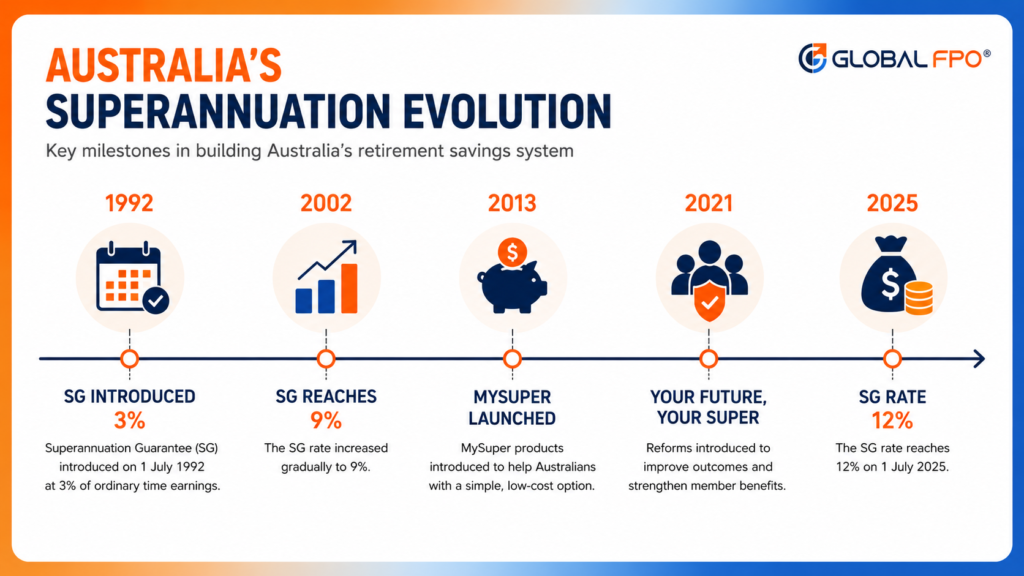
Evolution of Superannuation in Australia

Here is what the timeline looked like before widespread reforms:

Key Milestones in Australia’s Superannuation History

Year Milestone
Mid-1800s Early superannuation schemes introduced for select civil servants, bank employees, and white-collar workers.
1970s Super coverage reaches about 32% of wage earners through industrial awards.
1983 Prices and Incomes Accord redirects a proposed 3% wage increase into employer-funded super contributions.
1980s Industry super funds emerge across major sectors.
Jul 1992 Superannuation Guarantee (SG) introduced, making employer contributions compulsory at 3%.
2002 SG rate reaches 9%.
Jul 2005 Super Choice reforms allow most employees to choose their super fund.
2007 Better Super reforms make many super benefits tax-free for Australians aged 60+.
2013 MySuper launches as the default low-cost super product.
2018 Downsizer contributions introduced for eligible retirees.
2019 Protecting Your Super reforms cap fees on low-balance accounts.
2020 Temporary COVID-19 early-release scheme introduced.
Jul 2021 Your Future, Your Super reforms introduce fund stapling.
Feb 2022 Sunsuper and QSuper merge to form Australian Retirement Trust (ART).
Jul 2025 SG rate reaches 12%.

This stage became an important part of Australia’s superannuation history.

By the mid-twentieth century, only around one-third of white-collar workers had access to employer-funded retirement benefits. Blue-collar workers, casual employees, and many women had little retirement protection.

As Australia’s workforce expanded, the limitations of the system became increasingly obvious.

Why Superannuation Needed Reform

By the late 1970s and early 1980s, several problems started affecting Australia’s retirement system.

Many workers approached retirement with very limited savings. The Australian Government Treasury had also identified concerns about Australia’s long-term retirement income system. Policymakers recognised that an ageing population would place increasing pressure on public spending through the Age Pension if workers did not build greater private retirement savings.

There were also large inequalities between industries. Some employees had strong retirement benefits, while others had nothing at all.

Several key issues pushed Australia toward reform:

  1. Rising pressure on the Age Pension system
  2. Unequal retirement access across industries
  3. Limited retirement savings for average workers
  4. Growing workforce participation across different sectors
  5. Financial insecurity among older Australians

These concerns created momentum for large-scale retirement reforms.

The ACTU and the Push for Industry-Wide Super

The major turning point arrived during the 1980s.

The Australian Council of Trade Unions (ACTU) became a driving force behind expanding workplace retirement savings. Working through the Prices and Incomes Accord negotiated with the Hawke Government, the ACTU advocated for employer-funded superannuation across a broader range of industries.

Between 1983 and 1987, unions, employers, and government policymakers negotiated award-based superannuation arrangements that would eventually lay the foundation for compulsory super.

A major breakthrough occurred during the 1986 National Wage Case, which allowed employers to provide superannuation contributions through industrial awards rather than direct wage increases.

This marked a significant shift in Australia’s retirement savings landscape and created the foundation for the future Superannuation Guarantee system. The reforms also improved access for workers who previously had limited financial protection after retirement.

When Did Compulsory Superannuation Start in Australia?

Compulsory superannuation officially started on 1 July 1992, when the Superannuation Guarantee (Administration) Act 1992 came into effect.

If we dive into the history, the reform was introduced by the Paul Keating Government, building on retirement policy initiatives developed during the Bob Hawke Government. The legislation established the Superannuation Guarantee (SG) system, requiring employers to make compulsory contributions to eligible employees’ superannuation funds.

The original contribution rate started at 3%.

Although the percentage seems small today, the reform completely changed Australia’s retirement system.

The government introduced compulsory super for several important reasons:

  • To reduce future dependence on the Age Pension
  • To help workers build retirement savings gradually
  • To improve long-term financial stability
  • To strengthen Australia’s economy through national savings growth

Compulsory superannuation quickly became one of the country’s most important financial reforms.

How Superannuation Contribution Rates Increased Over Time

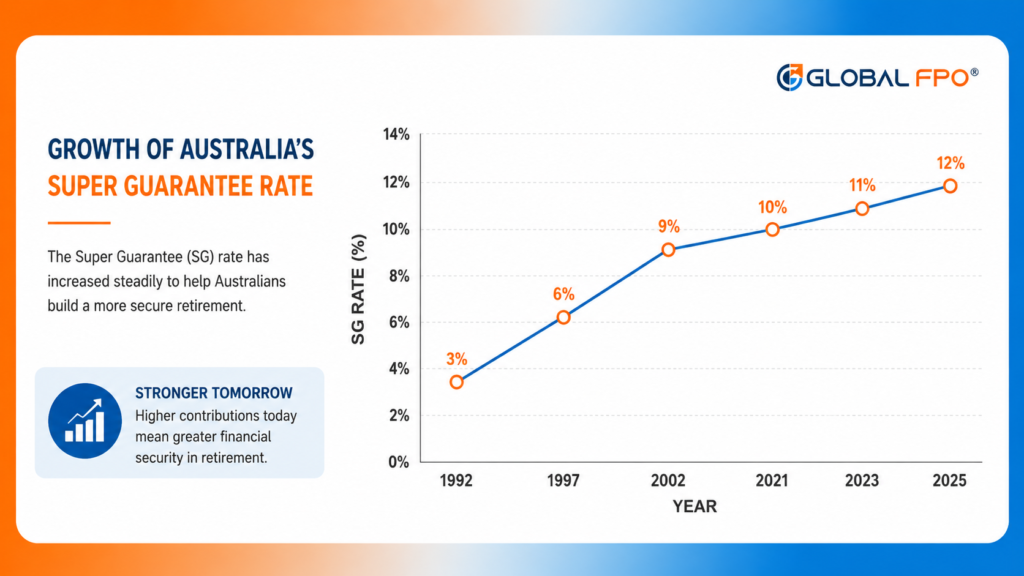
The Superannuation Guarantee rate did not remain at 3%. Over the following decades, the contribution percentage increased gradually to improve retirement outcomes for Australian workers.

Superannuation Contribution Rates

Superannuation Contribution RatesHere is a quick overview:

Year Super Guarantee Rate
1992 3%
Late 1990s 7%
Early 2000s 9%
2021 10%
2023 11%
2025–2026 12%

The increase to 12% reflects the growing importance of long-term retirement savings in Australia.

For employers, however, these changes also increased payroll responsibilities and compliance requirements.

Businesses now need accurate systems for:

That is why many businesses work with Global FPO to manage bookkeeping, payroll operations, and compliance support more efficiently.

Is Superannuation Taxed in Australia?

Yes, superannuation is generally taxed, although the system includes tax advantages designed to encourage retirement savings.

Here is a simple breakdown:

Super Component Typical Tax Treatment
Employer contributions Usually taxed at 15%
Investment earnings May be taxed
Withdrawals after age 60 Often tax-free

The
Australian Taxation Office
(ATO) administers many aspects of Australia’s superannuation tax system, including contribution reporting, compliance monitoring, and employer Superannuation Guarantee obligations.

Australia’s super system encourages long-term investment while supporting retirement security.

For businesses, however, super tax reporting can become complex. Incorrect payments or delayed reporting may lead to penalties from the Australian Taxation Office.

What Is Superannuation Day?

There is no official national event or public holiday known as “Superannuation Day” in Australia. Instead, the term is sometimes used informally during superannuation awareness campaigns, financial literacy initiatives, or discussions about employer contribution deadlines.

For employers, the most important superannuation dates are the quarterly Superannuation Guarantee (SG) payment deadlines and, from 1 July 2026, the introduction of Payday Super rules requiring contributions to be paid much closer to employee pay cycles. The Australian Taxation Office (ATO) monitors compliance with these obligations.

For employees, these reminders encourage regular reviews of:

  • Retirement balances
  • Contribution levels
  • Fund performance
  • Long-term financial goals

As retirement planning becomes increasingly important, super awareness continues growing across Australia.

Why Is Superannuation So Crucial in 2026?

Modern superannuation in Australia now affects nearly every Australian employer and employee. For workers, super provides long-term financial security after retirement. For businesses, it creates ongoing payroll, compliance, and reporting responsibilities.

Managing super accurately requires:

  1. Reliable payroll systems
  2. Accurate contribution calculations
  3. Timely reporting
  4. Proper financial record management
  5. Consistent compliance monitoring

The Australian Taxation Office actively monitors employer compliance with Superannuation Guarantee requirements. Businesses that fail to make contributions on time may face Super Guarantee Charge liabilities, interest charges, and additional penalties. Even small payroll mistakes can create costly compliance problems later.

That is one reason many businesses partner with Global FPO for bookkeeping, payroll management, and financial reporting support.

Simplify Superannuation Compliance with Global FPO

Australia’s superannuation system has come a long way since compulsory contributions were introduced in 1992. What began as a 3% employer obligation has evolved into a complex framework involving payroll accuracy, contribution deadlines, tax reporting, recordkeeping, and ongoing compliance with Australian Taxation Office requirements.

For growing businesses, managing these responsibilities internally can become time-consuming and increase the risk of costly errors. Missed deadlines, incorrect calculations, or reporting mistakes can lead to penalties and unnecessary administrative burden.

That’s why many businesses choose to streamline their finance operations with expert support. By outsourcing payroll, bookkeeping, and compliance processes, finance teams can spend less time navigating administrative requirements and more time focusing on growth.

Global FPO helps businesses build efficient back-office processes, maintain accurate financial records, and stay on top of evolving compliance obligations, allowing business owners to operate with greater confidence and control.

FAQs

Que: 1. When did superannuation start in Australia?

Ans. Compulsory superannuation officially started on July 1, 1992, through the Superannuation Guarantee legislation.

Que: 2. What is the Superannuation Guarantee?

Ans. The Superannuation Guarantee requires employers to contribute a percentage of employee earnings into super funds.

Que: 3. Is superannuation taxed?

Ans. Yes. Employer contributions and investment earnings are generally taxed under Australian superannuation laws.

Que: 4. When did superannuation start for women in Australia?

Ans. Women gained broader access during workplace reforms introduced throughout the 1980s and early 1990s.

Que: 5. What was the original super contribution rate?

Ans. The original compulsory employer contribution rate started at 3% in 1992.

Que: 6. Why is superannuation important for employers?

Ans. Businesses must manage payroll, reporting, and compliance obligations accurately to avoid penalties.

Que: 7. How can Global FPO help businesses with superannuation compliance?

Ans. Global FPO supports businesses with payroll processing, bookkeeping, compliance support, and financial reporting services.

Benefits of Outsourcing Payroll Services for Small Business

For small businesses, payroll can be a big headache. With so many state and federal regulations to comply with, it's no wonder that many business owners choose to outsource their payroll services. Not only does this free up valuable time and resources, but it can also save you money in the long run.

When you outsource your payroll services, you can rest assured that your payroll will be handled by experts who are up to date on all the latest regulations. But how do you know which payroll service provider is right for your business? we will explore the benefits of outsourcing payroll services and how to choose the right provider for your business.

What are the Benefits of Outsourcing Payroll Services?

There are several benefits of outsourcing payroll services, including:

Cost savings: Outsourcing payroll can be more cost-effective than handling payroll in-house, especially for small businesses that may not have the resources to invest in payroll software or hire dedicated payroll staff.

Accuracy: Payroll service providers are experts in their field and can ensure that payroll is processed accurately and on time. This can help reduce the risk of errors and fines for non-compliance.

Time-saving: Outsourcing payroll frees up time for business owners and their staff to focus on other tasks, such as growing the business and serving customers.

Compliance: Payroll service providers stay up to date on the latest tax laws and compliance requirements, so businesses can be confident that they are meeting all their obligations.

Security: Payroll service providers often have robust security measures in place to protect sensitive employee and financial data.

Overall, outsourcing payroll services can help businesses save time and money, and reduce their risk of errors, while also ensuring compliance with tax laws and regulations.

How to Choose a Reliable Payroll Service Provider

Your payroll service provider is one of your most important businesses. They will be responsible for ensuring that your employees are paid on time and that all tax withholdings and other deductions are handled correctly. You need to be sure that you can trust your payroll service provider to do their job correctly and that they will always be there when you need them.

There are several factors to consider when choosing a payroll service provider:

Cost: Determine your budget and compare prices from multiple providers to find the best value.

Services offered: Make sure the provider offers the services you need, such as payroll processing, tax filing, and employee onboarding.

Ease of use: Choose a provider with a user-friendly interface and good customer support.

Security: Make sure the provider has strong security measures in place to protect your company's and your employee’s personal and financial information.

Reputation: Look for a provider with a good reputation in the industry and read online reviews from other customers.

Flexibility: Choose a provider that can adapt to your company's changing needs and can integrate with other systems you use.

Scalability: Choose a provider that can handle your current payroll needs and can handle your company's future growth.

The Different Types of Payroll Processing Services

There are many payroll processing services available to businesses today. With so many options on the market, it can be difficult to know which one is right for your company. Here is a brief guide to the different types of payroll processing services available, so you can make an informed decision about which one is best for your business.

1. Full-service payroll providers: These companies will handle all aspects of payroll for your business, from calculating taxes to issuing paychecks.

2. Online payroll services: These services allow you to process payroll yourself, using an online interface.

3. Payroll software: This software is installed on your company’s computers, and you use it to process payroll internally.

4. Payroll outsourcing: This is when you hire a third-party company to handle all or part of your payroll processing.

5. Time and attendance tracking: This type of payroll service helps you track employee hours and attendance.

6. Workers’ compensation insurance: This type of payroll service provides insurance coverage for your employees in case they are

Outsourcing Tips to Consider Before Making the Decision

When it comes to payroll, there are a lot of factors to consider. But one of your most important decisions is whether to outsource your payroll services.

• Identify the specific tasks or functions that you want to outsource. This will help you find the right service provider and negotiate a fair price.

• Research potential service providers and compare their capabilities and prices. Look for providers with a proven track record and a good reputation in the industry.

• Consider the long-term costs and benefits of outsourcing. While outsourcing may save you money in the short term, it's important to consider how it will impact your business in the long run.

• Communicate your expectations clearly to the service provider. Clearly define the scope of work and establish clear lines of communication to ensure a smooth working relationship.

• Establish a contingency plan in case the outsourcing arrangement does not work out as planned. This could include maintaining in-house capabilities or identifying alternative service providers.

• Monitor the performance of the service provider and be open to adjusting as needed. Regularly review the outsourcing arrangement to ensure it is meeting your needs and making a positive impact on your business.

Conclusion

Outsourcing payroll services can provide several benefits for businesses, including cost savings, improved efficiency, and access to expert knowledge. When choosing a payroll service provider, it is important to consider your business's needs and the provider's reputation and experience.